Cloud ERP vs Traditional ERP 2026: Why Businesses Are Rapidly Moving to Cloud Solutions
 Admin
Admin Cloud ERP vs Traditional ERP: Which One is Better in 2026?
In the rapidly evolving business landscape of 2026, companies are under constant pressure to become more agile, data-driven, and cost-efficient. One of the most important decisions organizations face today is choosing between Cloud ERP vs Traditional ERP systems.
Enterprise Resource Planning (ERP) software has long been the backbone of business operations, helping companies manage finance, inventory, human resources, and customer data. However, with the rise of cloud ERP software, businesses are shifting away from legacy systems toward more flexible and scalable solutions.
In this detailed guide, we’ll compare cloud ERP vs traditional ERP, explore their benefits, and help you decide which solution is best for your business—while also highlighting how Borgdesk can support your digital transformation journey.
What is ERP Software?
ERP (Enterprise Resource Planning) software is a centralized system that integrates various business processes into one unified platform. It helps businesses streamline operations, improve productivity, and make data-driven decisions.
ERP systems come in two primary varieties:
- Cloud ERP Software (hosted on the cloud)
- Traditional ERP Software (installed on local servers)
Understanding the difference between these two is essential when choosing the right system for your business.
What is Cloud ERP?
Cloud ERP software is a web-based solution hosted on remote servers and accessed through the internet. It eliminates the need for on-premise infrastructure and allows businesses to operate from anywhere.
Key Features of Cloud ERP
- Remote accessibility from any device
- Automatic updates and maintenance
- Subscription-based pricing
- High scalability
- Real-time data access
Cloud ERP is becoming the preferred choice for modern businesses, especially those focusing on digital transformation for businesses.
What is Traditional ERP?
Traditional ERP, also known as on-premise ERP, is installed on a company’s internal servers and managed by its IT team.
Key Features of Traditional ERP
- Full control over data and system
- One-time licensing cost
- Customizable infrastructure
- Requires in-house IT management
- Limited remote access
While traditional ERP has been widely used for decades, it is gradually being replaced by more advanced cloud-based systems.
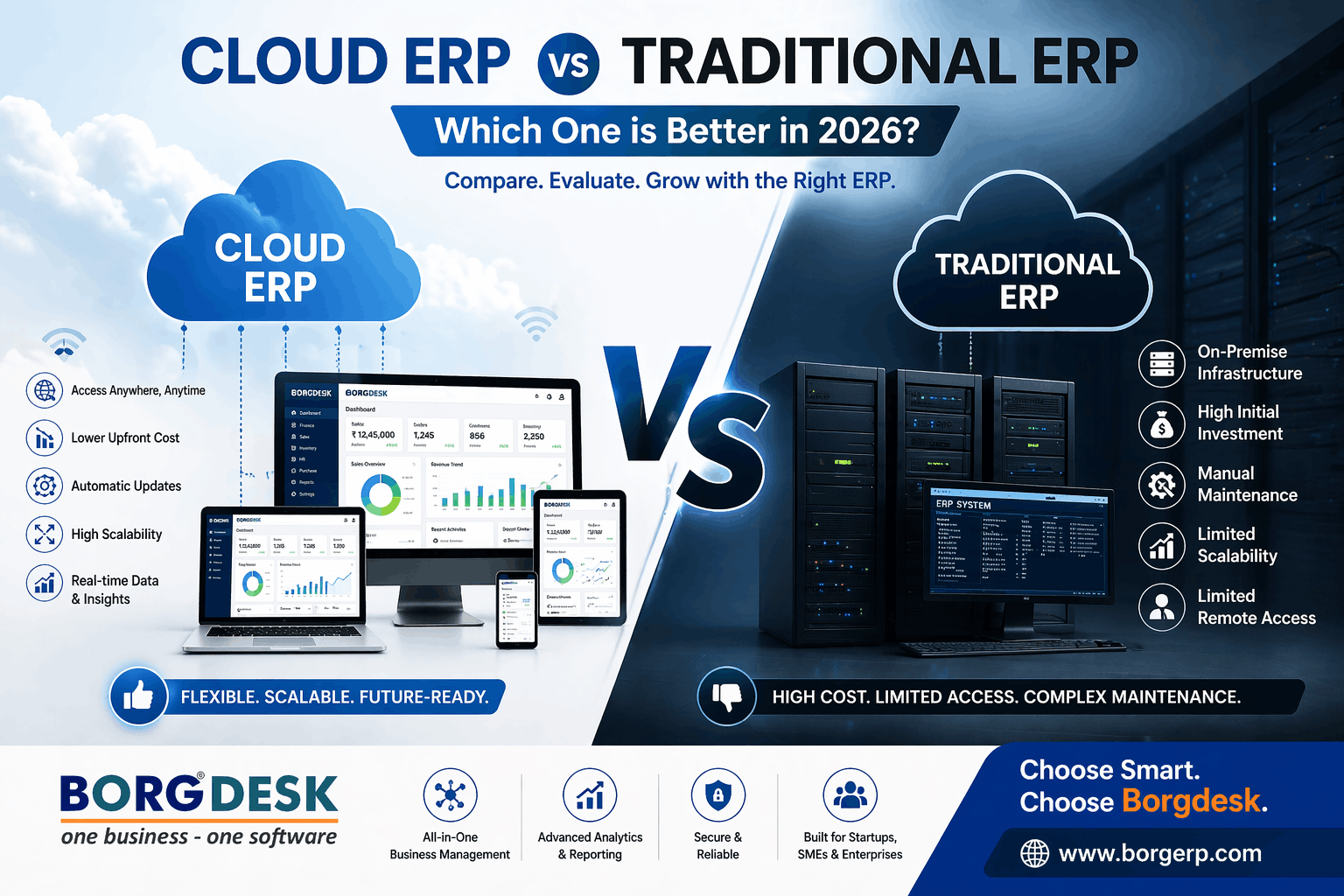
Cloud ERP vs Traditional ERP: Key Differences
1. Deployment & Accessibility
- Cloud ERP: Accessible anytime, anywhere via the internet
- Traditional ERP: Limited to on-site access
Cloud ERP wins for flexibility and remote work environments.
2. Cost Structure
- Cloud ERP: Subscription-based (lower upfront cost)
- Traditional ERP: High initial investment in hardware and licenses
Cloud ERP is ideal for businesses looking for affordable ERP software for startups.
3. Scalability
- Cloud ERP: Easily scalable as business grows
- Traditional ERP: Requires hardware upgrades for expansion
Cloud ERP offers better scalability for growing businesses.
4. Maintenance & Updates
- Cloud ERP: Managed by the provider with automatic updates
- Traditional ERP: Requires manual updates and IT support
Cloud ERP reduces maintenance burden significantly.
5. Security
- Cloud ERP: Advanced security protocols and data backups
- Traditional ERP: Depends on internal IT infrastructure
Both can be secure, but cloud providers often offer enterprise-level protection.
6. Implementation Time
- Cloud ERP: Faster deployment
- Traditional ERP: Time-consuming setup
Cloud ERP enables quicker adoption.
Benefits of Cloud ERP Software
1. Flexibility & Mobility
Employees can access the system from anywhere, making it ideal for remote teams.
2. Cost Efficiency
Lower upfront costs make it perfect for SMEs and startups.
3. Real-Time Data
Access to live data improves decision-making and operational efficiency.
4. Automatic Updates
You can stay up to date with the latest features without having to do anything.
5. Business Growth Support
Cloud ERP supports ERP software for growing businesses by scaling effortlessly.
Benefits of Traditional ERP
1. Full Control
Businesses have complete control over their data and infrastructure.
2. Customization
Highly customizable to meet specific business needs.
3. Offline Access
Can operate without internet connectivity.
4. Long-Term Investment
Suitable for large enterprises with stable operations and IT resources.
Challenges of Traditional ERP in 2026
While traditional ERP has its advantages, it faces several limitations in today’s fast-paced environment:
- High maintenance costs
- Limited scalability
- Lack of remote access
- Slower innovation and updates
These challenges make it less suitable for businesses aiming for rapid growth and digital transformation.
Why Cloud ERP is the Way of the Future for Business?
The shift toward cloud-based ERP software is not just a trend—it’s a necessity. Businesses are adopting cloud solutions to stay competitive and agile.
Key Reasons for Adoption
- Supports remote work culture
- Enables faster decision-making
- Reduces operational costs
- Improves collaboration across departments
Cloud ERP aligns perfectly with modern business needs and technological advancements.
How Borgdesk Helps You Choose the Right ERP?
When it comes to selecting the right ERP solution, Borgdesk offers a powerful and flexible platform tailored for modern businesses.
Why Choose Borgdesk Cloud ERP Solution?
1. All-in-One Business Management
Manage finance, inventory, HR, and CRM in one unified system.
2. Cloud-Based Accessibility
With secure cloud infrastructure, you may access your company's data at any time and from any location.
3. Scalable for All Business Sizes
Perfect for startups, SMEs, and enterprises.
4. Affordable Pricing
Ideal for businesses looking for low cost ERP software for small companies.
5. Easy Implementation
Quick setup ensures minimal disruption to operations.
6. Advanced Analytics
Gain insights with real-time reporting and data analytics.
Borgdesk ERP solution is designed to help businesses streamline operations and achieve sustainable growth in 2026 and beyond.
Which One is Better in 2026?
The answer depends on your business needs, but for most companies, Cloud ERP software is the clear winner in 2026.
Choose Cloud ERP If You:
- Want flexibility and remote access
- Need a scalable solution
- Prefer lower upfront costs
- Aim for digital transformation
Choose Traditional ERP If You:
- Require full control over infrastructure
- Have a dedicated IT team
- Operate in a highly regulated environment
Future Trends in ERP Software
New technologies are always changing the ERP landscape:
- Artificial Intelligence & Machine Learning
- Predictive Analytics
- Mobile ERP Applications
- Integration with IoT
- Enhanced Cybersecurity
These innovations are shaping the future of business management software and making ERP more powerful than ever.
Conclusion
The debate of Cloud ERP vs Traditional ERP clearly highlights the shift toward modern, flexible, and scalable solutions. While traditional ERP systems still have their place, cloud ERP is rapidly becoming the preferred choice for businesses in 2026.
If you want to stay competitive, improve efficiency, and drive growth, adopting a cloud-based ERP system is essential.
Borgdesk provides a reliable, scalable, and cost-effective ERP solution that empowers businesses to succeed in today’s digital era. Whether you’re a startup or an established enterprise, Borgdesk can help you transform your operations and achieve long-term success.
FAQs:
1. What is the main difference between cloud ERP and traditional ERP?
Cloud ERP is hosted online and accessible via the internet, while traditional ERP is installed on local servers.
2. Which ERP is more cost-effective?
Cloud ERP is generally more cost-effective due to lower upfront costs and subscription-based pricing.
3. Is cloud ERP secure?
Yes, modern cloud ERP systems use advanced security measures and data encryption.
4. Can small businesses use ERP software?
Absolutely. Cloud ERP is ideal for small and medium businesses due to its affordability and scalability.
5. How long does ERP implementation take?
Cloud ERP can be implemented quickly, often within weeks, while traditional ERP may take months.
6. Why should I choose Borgdesk ERP?
Borgdesk offers a scalable, user-friendly, and affordable cloud ERP solution tailored for modern business needs.
Leave your thought here
Your email address will not be published. Required fields are marked *


Comments (0)