Service Desk: Customer Success vs. Customer Support — Why Modern Businesses Need Both
 Admin
Admin Service Desk: Customer Success vs. Customer Support — Why Modern Businesses Need Both
In today’s service-driven economy, customer expectations have changed.
Customers no longer want to simply raise a complaint and wait for a response. They expect quick resolution, proactive communication, visibility into service status and a consistent experience throughout their relationship with a company.
This is where a modern Service Desk becomes much more than an online support ticketing system.
It becomes a Customer Success engine.
Customer Support vs. Customer Success
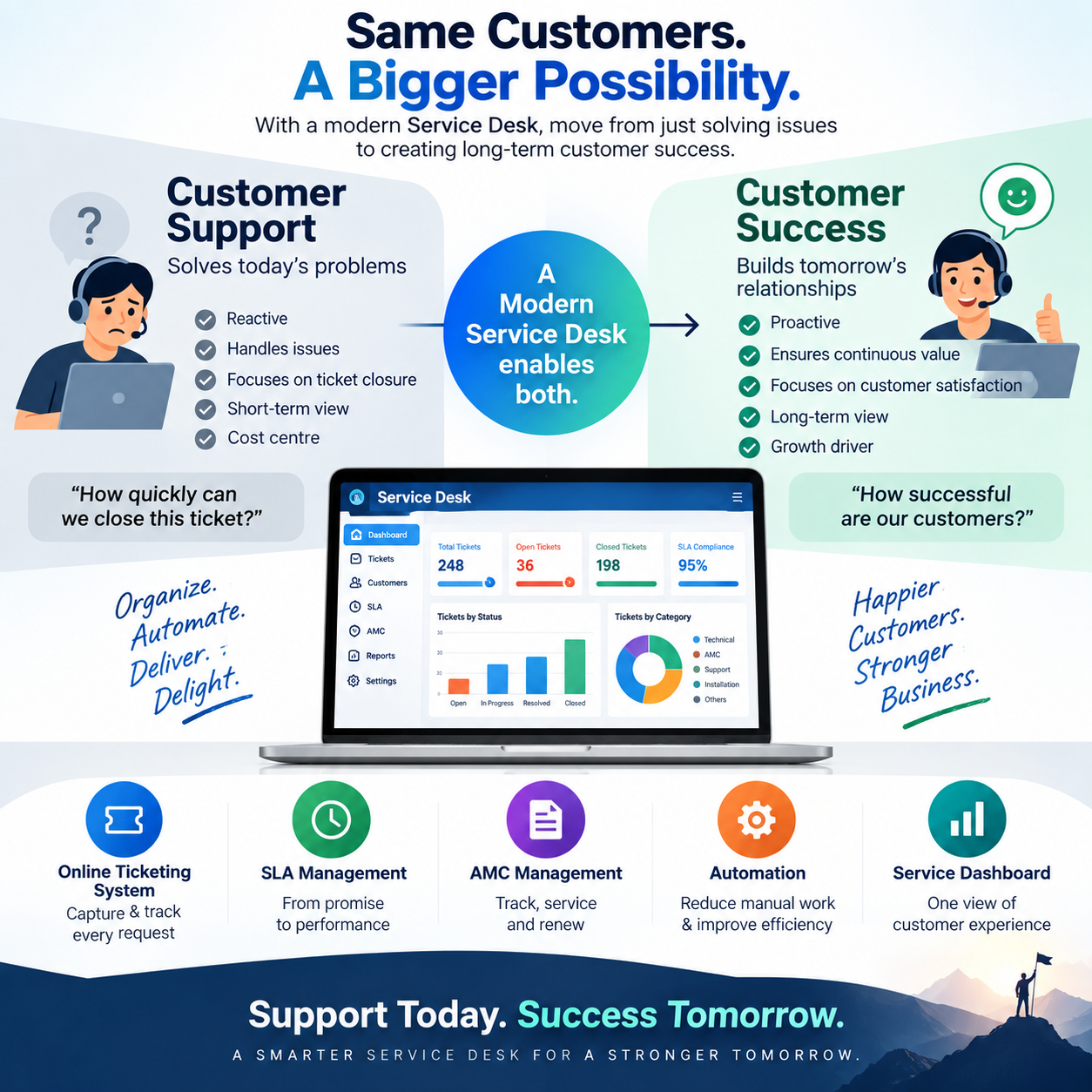
Customer Support and Customer Success are closely connected—but they are not the same.
Customer Support is reactive.
A customer faces an issue, raises a ticket, contacts the support team or sends a message. The support team responds, assigns the issue, works on it and closes the ticket.
Customer Success is proactive.
It focuses on ensuring that the customer continuously receives value from the product or service. It looks beyond individual complaints to understand service quality, recurring problems, SLA performance, AMC commitments, customer engagement and overall satisfaction.
Simply put:
Customer Support solves today's problem. Customer Success protects tomorrow's relationship.
A powerful Service Desk should help businesses achieve both.
From Support Ticketing to Customer Success
Traditional support systems mainly focus on:
-
Ticket creation
-
Ticket assignment
-
Issue resolution
-
Customer communication
-
Ticket closure
But service businesses need much more.
A modern Service Desk should connect the complete customer-service lifecycle:
Customer → Request → Ticket → Assignment → SLA → Resolution → Feedback → AMC → Renewal → Customer Success
This creates a structured and measurable service ecosystem.
Instead of relying on phone calls, WhatsApp messages, emails and spreadsheets, businesses can bring service operations onto a single digital platform.
Online Support Ticketing System
An effective online ticketing system creates a centralized platform where every customer issue or service request can be captured and tracked.
Customers can raise support requests while service teams can:
-
Create and categorize tickets
-
Assign tickets to employees or teams
-
Track ticket status
-
Set priorities
-
Monitor pending issues
-
Maintain complete communication history
-
Escalate overdue tickets
-
Track resolution time
-
Close tickets with proper documentation
The biggest advantage is visibility.
Management doesn't have to ask:
"How many customer complaints are pending?"
"Who is handling this issue?"
"Which tickets have crossed the SLA?"
"Which customers are repeatedly facing problems?"
The Service Desk dashboard can provide these answers instantly.
SLA Management: From Promise to Performance
Service businesses often make commitments such as:
-
Response within 2 hours
-
Resolution within 8 hours
-
On-site visit within 24 hours
-
Priority support for premium customers
But an SLA is valuable only when it is actually monitored.
A modern Service Desk can define SLA rules based on:
Customer + Service Type + Priority + Response Time + Resolution Time
The system can automatically monitor deadlines and highlight tickets approaching or crossing their SLA.
This helps management move from:
"We try to respond quickly."
to:
"Our service performance is measurable."
SLA dashboards can also help businesses identify teams, employees, customers or service categories where performance needs improvement.
AMC Management: Turning Service Into Recurring Revenue
For many service businesses, Annual Maintenance Contracts (AMC) are an important source of recurring revenue.
However, AMC management can become complicated when handled through spreadsheets and reminders.
A connected Service Desk can help businesses manage:
-
AMC customers
-
Contract start and end dates
-
Covered products/services
-
Service frequency
-
Preventive maintenance
-
Service requests
-
Contract-wise tickets
-
Engineer visits
-
Renewal reminders
-
AMC revenue
-
Customer service history
This creates a complete relationship view.
When a customer raises a ticket, the service team can immediately understand:
Who is the customer?
What contract do they have?
What services are covered?
What is their SLA?
What previous issues occurred?
When is the AMC due for renewal?
That is where Customer Support starts becoming Customer Success.
Service Dashboard: One View of Customer Experience
A service manager should not have to depend on multiple Excel sheets to understand the health of customer service.
A Service Desk dashboard can provide real-time visibility into:
Ticket Performance
-
Total tickets
-
Open tickets
-
Pending tickets
-
Closed tickets
-
Overdue tickets
SLA Performance
-
SLA compliance
-
SLA breaches
-
Response time
-
Resolution time
Team Performance
-
Tickets assigned
-
Tickets resolved
-
Pending workload
-
Employee productivity
Customer Performance
-
High-ticket customers
-
Repeat complaints
-
Customer satisfaction
-
Service history
AMC Performance
-
Active AMCs
-
Expiring AMCs
-
Renewal pipeline
-
Service utilization
Management gets the ability to identify problems before they become customer escalations.
Automation: The Foundation of a Scalable Service Desk
As the customer base grows, manual service management becomes increasingly difficult.
Automation can reduce repetitive work and improve response consistency.
For example:
Ticket Raised → Auto Acknowledgement → Auto Assignment → SLA Timer → Escalation → Resolution → Customer Feedback → Closure
Other workflows can include:
-
Automatic ticket notifications
-
SLA alerts
-
Escalation notifications
-
AMC expiry reminders
-
Follow-up reminders
-
Engineer assignment
-
Customer communication
-
Feedback collection
-
Management alerts
Automation doesn't replace the service team.
It allows the service team to spend less time managing processes and more time solving customer problems.
Customer Support Is a Cost. Customer Success Is an Investment.
If a company looks at customer support only as a cost centre, the focus generally becomes:
"How quickly can we close this ticket?"
But a Customer Success mindset asks:
"Why did this problem happen?"
"Is this customer getting the expected value?"
"Can we prevent this issue from recurring?"
"Is the customer likely to renew?"
"Can better service increase customer lifetime value?"
This change in thinking can transform the Service Desk from a back-office support function into a strategic business function.
Borg Desk Service Desk: Connecting Support With Customer Success
Borg Desk Service Desk is designed to help service-oriented businesses digitize and streamline their customer support and service operations.
Its Online Support Ticketing System brings together ticket management, customer support, SLA monitoring, AMC management, service workflows and dashboards into a connected workplace environment.
Instead of managing customer service through disconnected emails, calls, spreadsheets and messages, businesses can create a structured service process.
Borg Desk helps businesses:
Capture every customer request
↓
Assign it to the right person
↓
Track service progress
↓
Monitor SLA commitments
↓
Automate alerts and escalations
↓
Manage AMC and service contracts
↓
Measure team performance
↓
Collect customer feedback
↓
Improve customer success
The Future of Service Management
The future of customer service isn't simply about having a better ticketing system.
It is about creating a connected Customer Success ecosystem.
Businesses that can combine:
Support + Automation + SLA + AMC + Customer Data + Performance Analytics
will be better positioned to deliver consistent customer experiences as they scale.
Because the real objective of a Service Desk is not merely to close tickets.
It is to build customers who trust your service, continue using your products, renew their contracts and recommend your business.
Customer Support resolves the issue.
Customer Success strengthens the relationship.
A modern Service Desk enables both.
Borg Desk —
-
Turning service operations into a measurable, automated and customer-centric workplace.
-
Customer Support vs. Customer Success
-
From Support Ticketing to Customer Success
-
Online Support Ticketing System
-
SLA Management: From Promise to Performance
-
AMC Management: Turning Service Into Recurring Revenue
-
Service Dashboard: One View of Customer Experience
-
Automation: The Foundation of a Scalable Service Desk
-
Customer Support Is a Cost. Customer Success Is an Investment.
-
Borg Desk Service Desk: Connecting Support With Customer Success
-
The Future of Service Management
Service Desk: Customer Success vs. Customer Support
FAQ Schema Questions
What is a Service Desk?
A Service Desk is a centralized platform for managing customer or employee service requests, tickets, SLA commitments, communication, escalation and resolution.
What is the difference between Customer Support and Customer Success?
Customer Support is primarily reactive and focuses on resolving customer issues. Customer Success is proactive and focuses on helping customers achieve ongoing value and maintaining long-term relationships.
What is an Online Support Ticketing System?
It is a digital system that allows businesses to capture, assign, prioritize, track and resolve customer service requests through tickets.
Why is SLA management important?
SLA management helps businesses monitor response and resolution commitments, identify breaches and improve service accountability.
How does AMC management help service businesses?
AMC management helps businesses track maintenance contracts, service coverage, expiry dates, service requests and renewal opportunities.
Can Service Desk automation improve customer satisfaction?
Yes. Automated acknowledgements, assignments, reminders, SLA alerts and escalations can reduce delays and create a more consistent customer experience.
Leave your thought here
Your email address will not be published. Required fields are marked *


Comments (0)