Why Professional Services Firms Fail to Scale Without ERP Systems in 2026
 Admin
Admin Why Professional Services Firms Fail to Scale Without ERP Systems?
Professional services firms are evolving rapidly in 2026. Businesses in consulting, legal services, accounting, architecture, marketing agencies, IT services, engineering, and financial advisory sectors are facing increasing pressure to deliver projects faster, improve client experiences, manage remote teams, and maintain profitability.
However, many firms still rely on disconnected spreadsheets, manual reporting, outdated accounting tools, and multiple software platforms to manage daily operations. While this may work for small teams initially, it becomes a major obstacle when the business starts growing.
This is one of the biggest reasons why many professional services firms fail to scale successfully without an ERP system.
Modern ERP software helps businesses centralize operations, automate workflows, improve project management, and gain real-time visibility into performance. In this guide, we will explore why ERP systems are essential for scaling professional services businesses and how BORGDESK helps firms streamline operations efficiently.
What is ERP Software for Professional Services Firms?
ERP (Enterprise Resource Planning) software is a centralized business management system that integrates core operations such as:
- Project management
- Client management
- Accounting and invoicing
- Human resources
- Resource allocation
- Workflow automation
- Reporting and analytics
- Time tracking
- Financial management
Instead of using multiple disconnected tools, ERP software allows firms to manage all operations from one platform.
Also Read: " Best ERP Software for SMEs in India 2026 "
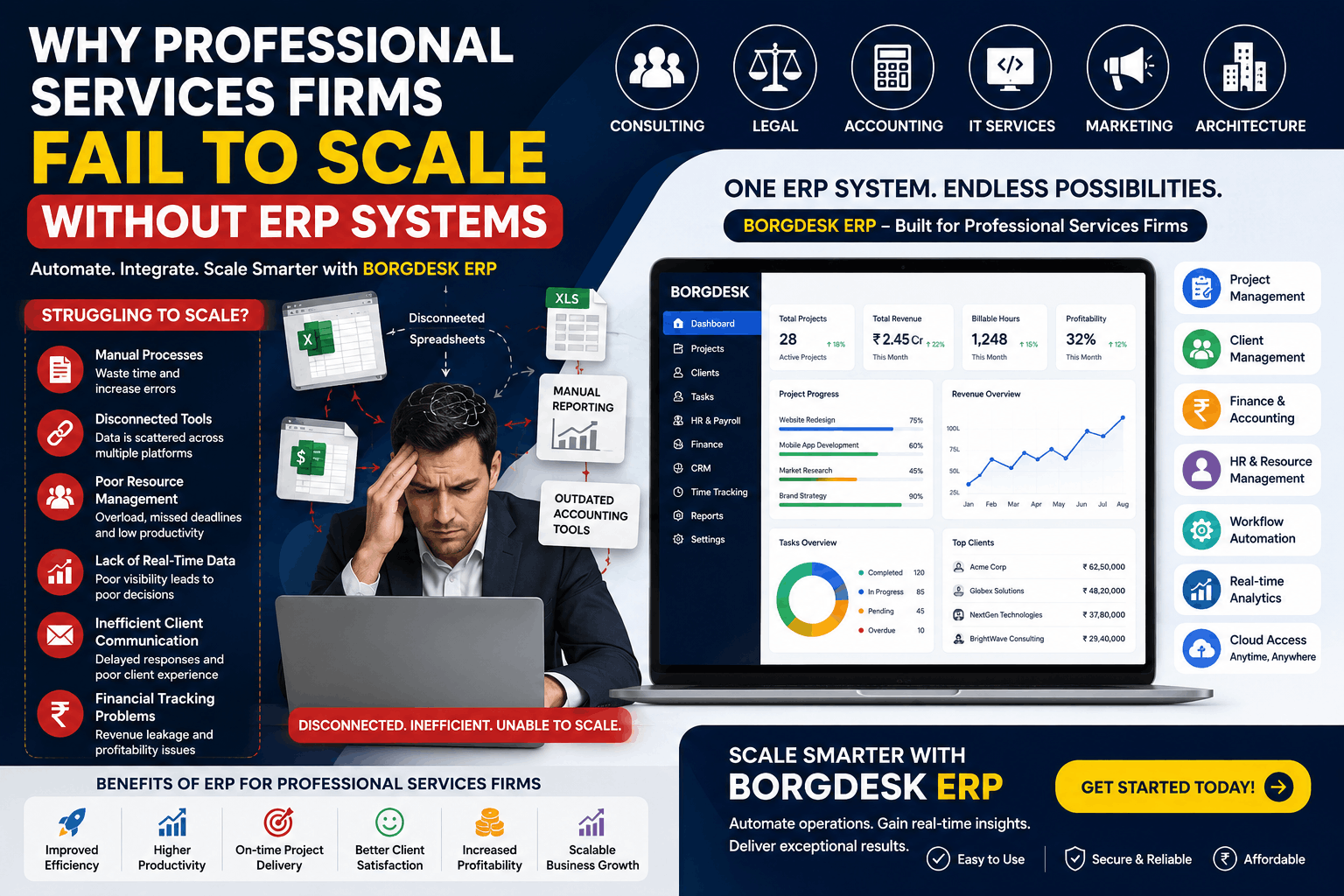
Why Professional Services Firms Struggle to Scale?
Many growing businesses face operational challenges that slow down expansion and reduce profitability.
Common Scaling Challenges
Manual Processes
Manual invoicing, reporting, payroll management, and project tracking waste valuable time and increase human errors.
Poor Resource Management
Without proper visibility, businesses struggle to allocate employees effectively across projects.
Lack of Real-Time Data
Decision-makers often lack accurate business insights because data is spread across multiple systems.
Inefficient Client Communication
Disconnected communication tools can lead to delayed responses and poor client experiences.
Financial Tracking Problems
Managing budgets, expenses, invoices, and profitability manually creates inefficiencies and revenue leakage.
Workflow Bottlenecks
Teams using multiple software tools often face duplication, delays, and operational confusion.
Also Read: " How to Scale Your Business with Automation Using Borgdesk ERP "
Why ERP Systems Are Essential for Business Scalability?
ERP software eliminates operational inefficiencies and creates a scalable business infrastructure.
1. Centralized Business Operations
One of the biggest advantages of ERP software is centralized management.
Instead of managing separate systems for:
- Finance
- HR
- Client management
- Projects
- Reporting
- Billing
ERP software combines everything into one unified platform.
This improves efficiency, transparency, and collaboration.
2. Improved Project Management
Professional services firms heavily depend on project execution and delivery.
ERP systems help firms:
- Track project timelines
- Monitor budgets
- Manage deadlines
- Allocate resources efficiently
- Improve team collaboration
Better project visibility helps businesses deliver services on time while maintaining profitability.
3. Better Financial Management
Financial visibility is critical for scaling service-based businesses.
ERP systems help firms manage:
- Accounts payable and receivable
- Invoicing and billing
- Revenue forecasting
- Expense tracking
- Profitability analysis
- Tax compliance
Automated financial management reduces errors and improves cash flow.
4. Enhanced Client Experience
In 2026, customer experience is one of the biggest competitive advantages.
ERP systems improve client relationships through:
- Faster communication
- Automated updates
- Better project transparency
- Accurate invoicing
- Faster support resolution
Satisfied clients are more likely to provide repeat business and referrals.
5. Automation of Repetitive Tasks
Manual tasks consume valuable business time.
ERP automation helps eliminate repetitive processes such as:
- Invoice generation
- Payroll processing
- Employee attendance tracking
- Expense approvals
- Task assignments
- Reporting
Automation improves productivity while reducing operational costs.
6. Real-Time Reporting and Analytics
Scaling businesses require data-driven decision-making.
ERP dashboards provide:
- Real-time business insights
- Project profitability reports
- Employee productivity tracking
- Revenue analytics
- Financial forecasting
- KPI monitoring
Real-time reporting helps management make faster and smarter business decisions.
Also Read: "Why Cloud ERP is Dominating India in 2026. "
Signs Your Professional Services Firm Needs an ERP System
Many businesses delay ERP implementation until operational problems become severe.
Here are some common warning signs.
Your Team Uses Multiple Disconnected Tools
If your company uses separate platforms for:
- Accounting
- HR
- CRM
- Project management
- Reporting
then operational inefficiencies are likely slowing growth.
You Struggle With Resource Allocation
Without proper workforce planning, firms often:
- Overload employees
- Miss deadlines
- Waste billable hours
- Reduce project profitability
ERP software improves workforce utilization.
Financial Reporting Takes Too Long
If monthly reports require manual spreadsheet work, your business may need ERP automation.
Modern ERP software generates reports instantly.
Client Communication Is Disorganized
Delayed emails, missed updates, and inconsistent support negatively impact client satisfaction.
ERP systems centralize customer communication and project tracking.
Business Growth Feels Chaotic
If scaling operations creates confusion instead of efficiency, ERP implementation becomes essential.
How ERP Software Improves Operational Efficiency?
Operational efficiency directly impacts profitability.
ERP systems streamline:
- Workflow management
- Team collaboration
- Resource planning
- Client management
- Financial operations
- Data management
Businesses that automate operations often scale faster and reduce unnecessary expenses.
Also Read: " Is Your Business Ready for ERP? 7 Signs You Need It Now."
Why BORGDESK is the Ideal ERP Solution for Professional Services Firms?
When choosing ERP software, businesses need a solution that is scalable, affordable, user-friendly, and automation-focused.
BORGDESK is designed to help professional services firms manage operations efficiently from one centralized platform.
Key Features of BORGDESK
Advanced ERP Automation
Automate repetitive workflows and reduce manual work.
Project Management Tools
Track project timelines, tasks, budgets, and team productivity.
CRM Integration
Manage customer relationships and client communication efficiently.
Financial Management
Handle invoices, billing, accounting, and expense tracking from one system.
Real-Time Analytics Dashboard
Monitor performance metrics and business growth instantly.
Team Collaboration Tools
Improve internal communication and workflow coordination.
Cloud-Based Accessibility
Access your business operations securely from anywhere.
Benefits of Using BORGDESK ERP Software
Professional services firms using BORGDESK can:
- Improve operational efficiency
- Increase team productivity
- Deliver projects faster
- Enhance customer satisfaction
- Reduce manual errors
- Improve profitability
- Scale business operations smoothly
Whether you run a consulting agency, law firm, accounting company, IT service provider, or marketing agency, BORGDESK helps simplify complex operations.
How to Choose the Right ERP System
Before selecting ERP software, businesses should evaluate:
Scalability
Can the system support future business growth?
Ease of Use
Is the platform user-friendly for employees?
Customization
Can workflows be customized for your business needs?
Integration Capabilities
Does it integrate with CRM, accounting, and communication tools?
Reporting Features
Does it provide advanced analytics and insights?
Support and Security
Reliable support and data protection are essential.
Also Read: " Cloud ERP vs Traditional ERP: Which One is Better in 2026? "
Scale Your Professional Services Firm with BORGDESK ERP
Struggling with manual operations, disconnected systems, and inefficient workflows?
BORGDESK helps professional services firms automate operations, improve project management, streamline financial processes, and scale efficiently from one powerful ERP platform.
Start transforming your business operations with BORGDESK today and unlock smarter growth in 2026.
Final Thoughts
Professional services firms cannot scale efficiently using outdated systems and manual processes. As businesses grow, operational complexity increases significantly.
ERP software provides the automation, visibility, and operational control required to manage growth successfully.
From project management and financial tracking to client communication and reporting, ERP systems help businesses improve efficiency and profitability.
For firms looking for a scalable and modern business management solution, BORGDESK offers powerful ERP capabilities designed specifically for growing businesses in 2026.
FAQs – Why Professional Services Firms Fail to Scale Without ERP Systems
1. What is ERP software for professional services firms?
ERP software helps service-based businesses manage projects, finances, employees, clients, reporting, and workflows from one centralized platform.
2. Why do professional services firms need ERP systems?
ERP systems improve operational efficiency, automate workflows, enhance project management, and provide real-time business insights for scaling operations.
3. Can ERP software improve client management?
Yes. ERP systems help businesses centralize communication, track projects, automate updates, and improve customer experience.
4. What are the benefits of cloud ERP software?
Cloud ERP solutions provide remote accessibility, real-time updates, scalability, lower infrastructure costs, and improved data security.
5. Is ERP software suitable for small professional services firms?
Yes. Small businesses can use ERP software to automate operations, improve productivity, and prepare for future growth.
6. Why is BORGDESK a good ERP solution for service businesses?
BORGDESK provides advanced automation, project management, CRM integration, analytics, financial management, and workflow optimization tools designed for growing professional services firms.
Leave your thought here
Your email address will not be published. Required fields are marked *


Comments (0)