How CRM and ERP Software Are Transforming Banking Customer Experience and Compliance in 2026
 Admin
Admin CRM and ERP in Banking: Enhancing Customer Experience and Compliance
The banking industry is evolving rapidly in 2026. Customers now expect faster services, personalized banking experiences, digital convenience, instant support, and secure transactions. At the same time, financial institutions must manage strict regulatory compliance, fraud prevention, risk monitoring, loan processing, customer onboarding, and data security.
Traditional banking management methods are no longer enough to handle these growing demands efficiently. This is where CRM (Customer Relationship Management) and ERP (Enterprise Resource Planning) software play a critical role.
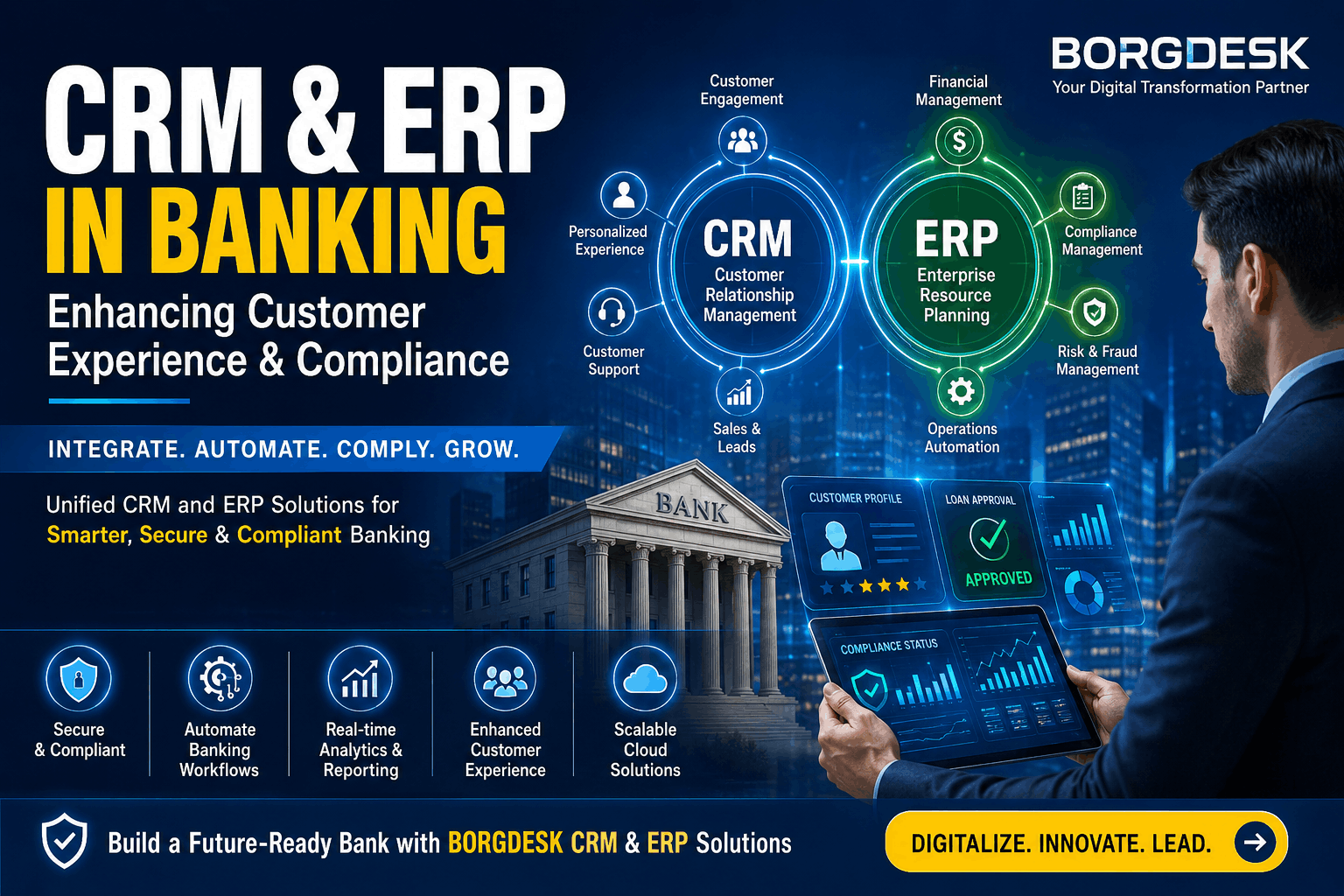
Modern banking institutions are now integrating CRM and ERP systems to streamline operations, improve customer relationships, automate compliance management, and increase profitability. Companies like BORGDESK are helping banks and financial institutions modernize their digital infrastructure with advanced CRM and ERP solutions tailored for the financial sector.
Also Read:“CRM and ERP Explained: Complete Guide for Growing Businesses”
What is CRM in Banking?
CRM in banking refers to software that helps financial institutions manage customer relationships, interactions, leads, communication history, support requests, and personalized financial services.
A banking CRM system allows banks to:
- Track customer interactions
- Manage customer data centrally
- Improve customer support
- Automate marketing campaigns
- Increase cross-selling opportunities
- Enhance customer retention
- Deliver personalized banking experiences
Banks use CRM software to build stronger customer relationships and improve customer satisfaction across all touchpoints.
Key Features of Banking CRM Software
1. Customer Data Management
CRM systems store customer information such as:
- Account history
- Transaction behavior
- Loan details
- Communication records
- Customer preferences
This helps banks deliver more personalized services.
2. Lead and Opportunity Management
Banking CRM platforms help manage:
- Loan inquiries
- Credit card applications
- Investment opportunities
- Insurance sales
- Customer onboarding
This improves conversion rates and sales efficiency.
3. Automated Customer Support
CRM systems automate:
- Ticket management
- Chat support
- Email responses
- Follow-ups
- Service reminders
This significantly improves customer experience.
4. Marketing Automation
Banks can automate:
- SMS campaigns
- Email marketing
- Customer segmentation
- Personalized offers
- Loyalty programs
This increases customer engagement and retention.
Also Read: “Best Enterprise CRM Systems for Scalable Business Growth 2026”
What is ERP in Banking?
ERP software helps banks manage core operational processes from a centralized system. It integrates departments such as finance, HR, compliance, procurement, accounting, risk management, and reporting.
ERP systems eliminate operational silos and improve overall banking efficiency.
Key Features of Banking ERP Software
1. Financial Management
ERP systems automate:
- Accounting
- Budgeting
- Financial reporting
- Revenue tracking
- Expense management
This improves financial accuracy and transparency.
2. Compliance and Regulatory Management
Banks must follow strict financial regulations. ERP systems help manage:
- KYC compliance
- AML compliance
- Audit tracking
- Regulatory reporting
- Risk monitoring
This reduces compliance risks and penalties.
3. Human Resource Management
ERP solutions streamline:
- Payroll
- Employee attendance
- Recruitment
- Performance management
- Workforce planning
This improves operational productivity.
4. Risk and Fraud Management
ERP systems help detect:
- Suspicious transactions
- Fraud patterns
- Security risks
- Data breaches
This enhances banking security and compliance.
Also Read:“All-in-One ERP Software for Smart Business Management| Borgerp”
Benefits of CRM and ERP Integration in Banking
Integrating CRM and ERP systems creates a unified banking ecosystem where customer data and operational processes work together seamlessly.
1. Enhanced Customer Experience
Banks can access real-time customer information instantly. This enables:
- Faster customer service
- Personalized financial recommendations
- Quick loan approvals
- Better issue resolution
- Improved customer satisfaction
Customers receive a smooth and connected banking experience.
2. Improved Regulatory Compliance
Financial institutions face strict regulations in 2026. Integrated ERP and CRM systems help banks maintain:
- Accurate documentation
- Audit-ready records
- Automated compliance checks
- Real-time reporting
- Secure data management
This reduces manual errors and compliance violations.
3. Better Data Management
CRM and ERP integration centralizes banking data into one platform. This improves:
- Data accuracy
- Reporting efficiency
- Decision-making
- Customer insights
- Operational transparency
Banks can make faster and smarter business decisions.
4. Increased Operational Efficiency
Automation reduces repetitive manual tasks such as:
- Customer onboarding
- Loan processing
- Compliance verification
- Report generation
- Account management
This saves time and reduces operational costs.
5. Stronger Security and Fraud Prevention
Modern ERP and CRM systems include:
- AI-powered fraud detection
- Data encryption
- User access control
- Real-time monitoring
- Risk alerts
This helps protect sensitive customer data and banking operations.
Also Read: “Sales CRM System: Features, Benefits & Complete Guide”
Why Banks Need CRM and ERP Software in 2026?
The banking sector is becoming more digital and customer-focused. Banks that still rely on outdated systems often struggle with:
- Slow operations
- Poor customer experience
- Compliance risks
- Data silos
- Security vulnerabilities
- High operational costs
Modern CRM and ERP software solutions solve these challenges by creating a centralized and automated banking management environment.
Financial institutions now require intelligent digital systems to remain competitive and compliant.
How BORGDESK Helps Banking Institutions?
BORGDESK provides advanced CRM and ERP solutions designed to help banks and financial institutions improve efficiency, customer engagement, and compliance management.
Why Choose BORGDESK?
Centralized Banking Operations
BORGDESK integrates customer management, finance, compliance, HR, and reporting into one powerful platform.
Advanced Automation
Automate repetitive banking processes including:
- Customer onboarding
- Lead management
- Loan workflows
- Compliance reporting
- Customer support
Enhanced Customer Relationship Management
Deliver personalized banking services using smart customer insights and automation tools.
Real-Time Analytics and Reporting
Access real-time financial reports, customer analytics, and compliance dashboards for faster decision-making.
Secure and Scalable Infrastructure
BORGDESK provides enterprise-grade security and scalable architecture suitable for growing financial institutions.
Best Practices for Implementing CRM and ERP in Banking
Define Clear Business Objectives
Before implementation, banks should identify:
- Operational challenges
- Compliance requirements
- Customer service goals
- Automation priorities
This ensures successful software deployment.
Choose Scalable Software
Select CRM and ERP solutions that can grow with your institution and adapt to future banking trends.
Prioritize Data Security
Banking systems must include:
- Data encryption
- Multi-factor authentication
- Access controls
- Backup systems
Security should always remain a top priority.
Train Employees Properly
Employee training is essential for maximizing software adoption and operational efficiency.
Monitor and Optimize Continuously
Banks should regularly analyze system performance and optimize workflows for better efficiency and customer experience.
Also Read: “Best ERP Software for SMEs in India 2026”
Future Trends of CRM and ERP in Banking
The future of banking technology will be driven by:
- Artificial Intelligence (AI)
- Predictive analytics
- Cloud banking solutions
- Automation
- Blockchain integration
- AI-powered customer support
- Real-time compliance monitoring
Banks adopting intelligent CRM and ERP solutions will gain a major competitive advantage in the digital banking era.
Also Read: “The Future of ERP Software in 2026- BORGDESK”
Why CRM and ERP Are Essential for Customer Experience?
Customer expectations in banking have changed dramatically. Today’s customers expect:
- 24/7 support
- Personalized banking
- Faster transactions
- Digital convenience
- Secure services
CRM systems help banks understand customer behavior, while ERP systems ensure smooth backend operations. Together, they create a seamless customer experience that increases trust, loyalty, and retention.
Conclusion
CRM and ERP software are transforming the banking industry in 2026. These systems help banks improve customer experiences, automate operations, enhance regulatory compliance, strengthen security, and increase profitability.
Financial institutions that invest in modern digital solutions can deliver faster, smarter, and more secure banking services while remaining competitive in an increasingly digital market.
If your banking institution wants to improve operational efficiency, automate compliance management, and deliver exceptional customer experiences, BORGDESK provides powerful CRM and ERP solutions tailored for modern financial organizations.
Transform Your Banking Operations with BORGDESK
Looking to modernize your banking infrastructure and improve customer satisfaction?
BORGDESK helps financial institutions:
- Automate banking workflows
- Improve customer engagement
- Simplify compliance management
- Increase operational efficiency
- Enhance data security
- Streamline reporting and analytics
Start your digital banking transformation today with BORGDESK and empower your financial institution with intelligent CRM and ERP solutions.
FAQs About CRM and ERP in Banking
1. What is CRM in banking?
CRM in banking is software used to manage customer relationships, communication, customer data, support services, and sales opportunities to improve customer experience and retention.
2. What is ERP software in banking?
ERP software helps banks manage core operational processes such as accounting, compliance, HR, finance, procurement, reporting, and risk management from a centralized platform.
3. Why is CRM important for banks?
CRM helps banks provide personalized customer experiences, improve customer support, automate marketing campaigns, and increase customer retention.
4. How does ERP improve compliance in banking?
ERP systems automate compliance workflows, audit tracking, regulatory reporting, and risk management, helping banks meet regulatory requirements more efficiently.
5. Can CRM and ERP be integrated in banking?
Yes, integrating CRM and ERP systems creates a unified platform that improves operational efficiency, customer service, reporting, and compliance management.
6. What are the benefits of CRM and ERP integration?
Key benefits include:
- Better customer experience
- Faster operations
- Improved compliance
- Centralized data management
- Enhanced security
- Increased profitability
7. Why should banks choose BORGDESK?
BORGDESK offers scalable CRM and ERP solutions designed specifically to help financial institutions automate operations, improve customer engagement, and maintain regulatory compliance efficiently
Leave your thought here
Your email address will not be published. Required fields are marked *


Comments (0)