Why Healthcare Providers Are Rapidly Adopting Integrated CRM and ERP Software
 Admin
Admin Why Healthcare Providers Need Integrated CRM and ERP Software?
The healthcare industry is undergoing rapid digital transformation. From patient management to billing and compliance, healthcare providers must handle complex operations while delivering exceptional patient experiences. Relying on disconnected systems often leads to inefficiencies, errors, and poor coordination.
This is why adopting Integrated Crm And Erp Software has become essential for modern healthcare organizations. By combining patient relationship management with operational efficiency, healthcare providers can streamline processes, improve outcomes, and enhance overall performance.
What is Integrated CRM and ERP Software?
Integrated CRM and ERP software combines two powerful systems:
- CRM (Customer Relationship Management): Manages patient interactions, communication, and engagement.
- ERP (Enterprise Resource Planning): Handles backend operations like finance, inventory, HR, and compliance.
When integrated, these systems create a unified platform that connects patient data with operational workflows, enabling smarter decision-making and seamless coordination.
VISIT:CRM for Healthcare: Manage Patients & Improve Engagement .
Why Healthcare Providers Need Integrated CRM and ERP Software?
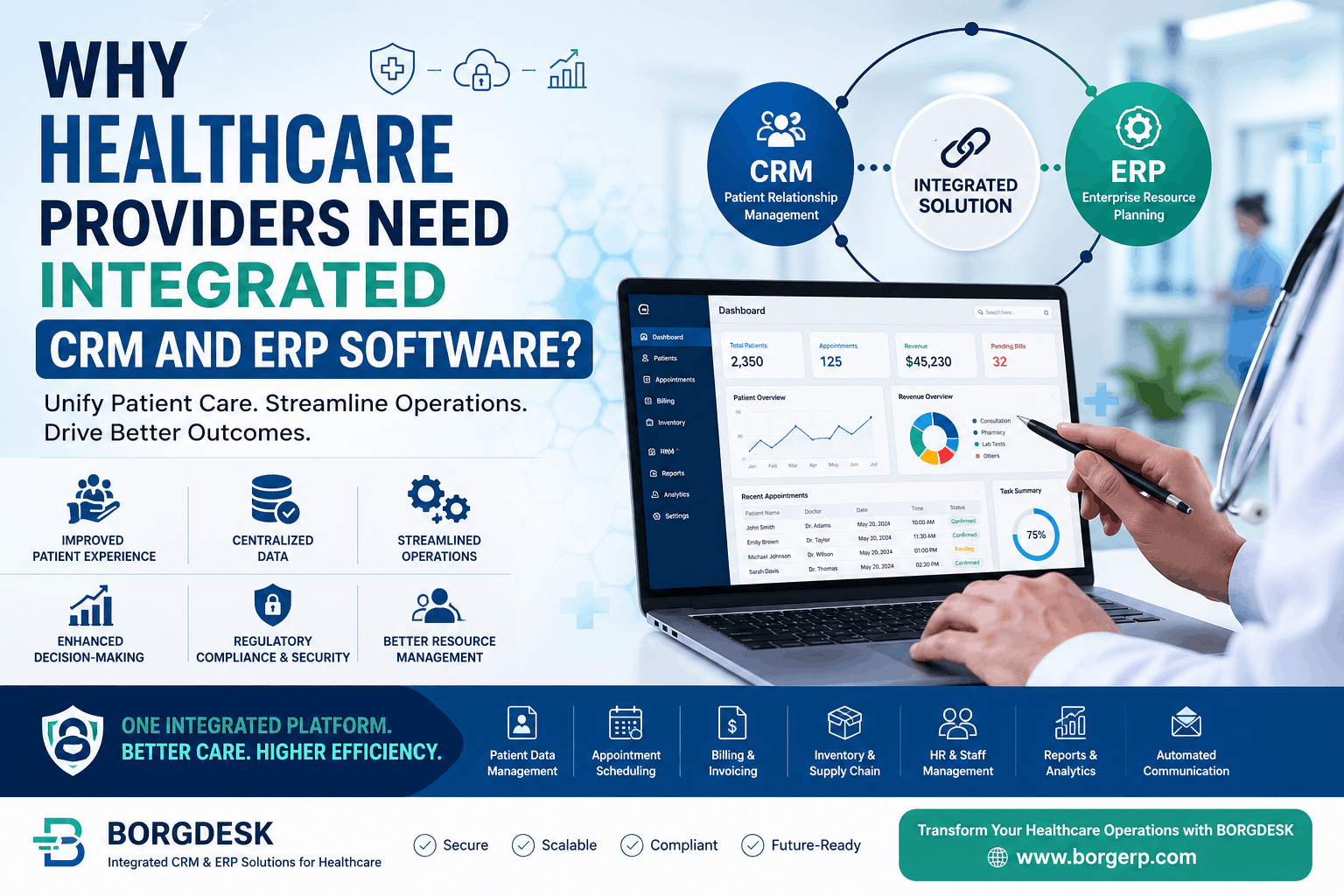
1. Improved Patient Experience
Patients expect personalized and timely care. A healthcare CRM helps track patient history, preferences, and communication, while ERP ensures smooth backend operations.
Together, they enable:
- Faster appointment scheduling
- Personalized communication
- Better follow-ups and care management
2. Centralized Data Management
Healthcare providers deal with massive amounts of data daily. Without integration, data silos can create confusion and errors.
An integrated system provides:
- Single source of truth
- Real-time data access
- Improved data accuracy
3. Streamlined Operations
ERP systems automate core processes like billing, procurement, and HR, while CRM manages patient interactions.
This integration results in:
- Reduced manual work
- Faster workflows
- Better coordination between departments
4. Enhanced Decision-Making
With combined insights from CRM and ERP, healthcare providers can make data-driven decisions.
Benefits include:
- Predictive analytics for patient care
- Financial forecasting
- Resource optimization
5. Regulatory Compliance & Data Security
Healthcare organizations must comply with strict regulations. Integrated systems help maintain compliance by:
- Securing patient data
- Maintaining audit trails
- Automating reporting
6. Better Resource Management
ERP helps manage hospital resources such as staff, equipment, and inventory, while CRM ensures patient needs are met efficiently.
This leads to:
- Optimal resource utilization
- Reduced operational costs
- Improved service delivery
VISIT: How to Build a Healthcare Market Research Platform.
Key Features of Integrated Healthcare CRM & ERP Systems
- Patient data management
- Appointment scheduling
- Billing and invoicing
- Inventory and supply chain management
- Staff and HR management
- Reporting and analytics
- Automated communication tools
Real-World Use Case
Imagine a hospital using separate systems for patient records and billing. A delay in updating patient data can lead to billing errors and poor patient experience.
With integrated CRM and ERP:
- Patient information updates instantly
- Billing becomes accurate and automated
- Staff coordination improves
Why Choose BorgERP for Healthcare CRM & ERP?
At BORGDESK, we provide advanced integrated CRM and ERP solutions tailored for healthcare providers. Our platform helps hospitals, clinics, and healthcare businesses:
- Improve patient engagement
- Automate workflows
- Reduce operational costs
- Ensure data security and compliance
With scalable and customizable solutions, BorgERP empowers healthcare organizations to grow efficiently in a competitive digital landscape.
Conclusion
Integrated CRM and ERP software is no longer a luxury—it’s a necessity for healthcare providers aiming to deliver high-quality care while maintaining operational efficiency. By unifying patient management with backend processes, healthcare organizations can enhance productivity, reduce errors, and improve patient satisfaction.
If you're looking to modernize your healthcare operations, adopting an integrated solution like BORGDESK can be a game-changer.
FAQs
1. What is the main benefit of integrated CRM and ERP in healthcare?
The main benefit is improved efficiency by combining patient management with operational processes in a single system.
2. How does CRM help in healthcare?
CRM helps manage patient interactions, improve communication, and enhance patient engagement.
3. Why is ERP important for hospitals?
ERP streamlines backend operations like billing, inventory, and HR, improving overall efficiency.
4. Is integrated CRM and ERP software secure for healthcare data?
Yes, modern systems include advanced security features and comply with healthcare regulations to protect sensitive data.
5. Can small clinics use integrated CRM and ERP systems?
Absolutely. Scalable solutions like those offered at BORGDESK are suitable for both small clinics and large hospitals.
Leave your thought here
Your email address will not be published. Required fields are marked *


Comments (0)