How CRM & ERP Integration is Driving Omnichannel Retail Success | BORGDESK
 Admin
Admin Omnichannel Retail Success Made Easy with CRM & ERP Integration | BORGDESK
In today’s highly competitive retail landscape, customers expect a seamless shopping experience across multiple channels—whether it’s online, in-store, mobile apps, or social media. Businesses that fail to meet these expectations risk losing customers to more agile competitors.
This is where Omnichannel Retail powered by CRM and ERP integration becomes a game-changer. By combining customer data with operational efficiency, businesses can create a unified, personalized, and highly efficient retail experience.
In this blog, we’ll explore how integrating CRM and ERP systems can help retailers reduce costs, improve customer satisfaction, and achieve omnichannel success—with smart solutions from BORGDESK.
What is Omnichannel Retail ?
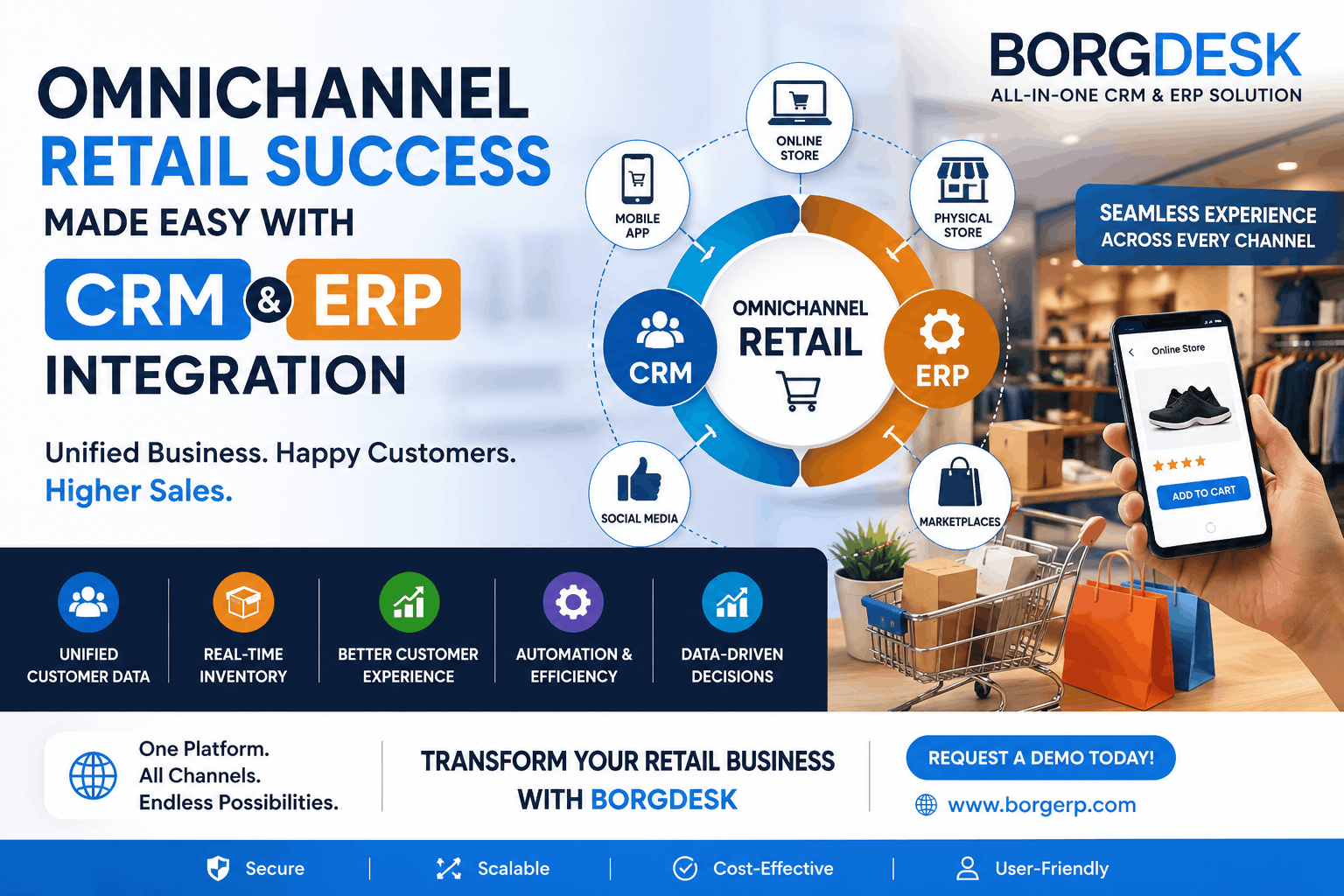
Omnichannel retail refers to a strategy that provides customers with a seamless and consistent shopping experience across all platforms—online stores, physical shops, mobile apps, marketplaces, and social media.
Unlike multichannel retail, omnichannel ensures that all channels are interconnected. For example:
- A customer can browse products online and purchase in-store
- They can return an online order at a physical location
- Customer data remains consistent across all platforms
To achieve this level of integration, businesses need powerful tools like CRM (Customer Relationship Management) and ERP (Enterprise Resource Planning) systems.
Also read: “Top 5 Test Management Tools for ERP and CRM Software Testing in 2026 “
Why Retail Success Requires CRM and ERP Integration ?
Retail businesses generate massive amounts of data daily—from sales transactions to customer interactions. Without integration, this data remains siloed, leading to inefficiencies and poor decision-making.
Key Benefits of CRM & ERP Integration:
1. Unified Customer Data
CRM systems collect customer data such as purchase history, preferences, and behavior. When integrated with ERP, this data connects with inventory, billing, and order management.
Result: Personalized shopping experiences and better targeting.
2. Real-Time Inventory Management
With ERP integration, retailers can track inventory across all channels in real time.
- No more overselling or stockouts
- Better warehouse and supply chain management
3. Improved Customer Experience
By combining CRM insights with ERP operations, businesses can:
- Provide faster order fulfillment
- Offer personalized recommendations
- Deliver consistent service across channels
4. Increased Efficiency & Automation
Automation reduces manual work and human errors:
- Automated order processing
- Smart invoicing and billing
- Streamlined supply chain
5. Data-Driven Decision Making
Integrated systems provide real-time reports and analytics:
- Sales performance
- Customer trends
- Inventory insights
How BORGDESK Powers Omnichannel Retail Success ?
When it comes to Retail ERP CRM Software, BORGDESK (borgerp.com) stands out as a powerful, all-in-one solution designed for modern businesses.
Key Features of BORGDESK:
1. Centralized Data Management
BORGDESK integrates CRM and ERP into a single platform, ensuring all your business data is synchronized and accessible.
2. Smart Inventory Tracking
Track stock levels across warehouses and retail outlets in real time with advanced inventory management tools.
3. Customer Insights & Personalization
Understand customer behavior and create personalized marketing campaigns using CRM analytics.
4. Seamless Omnichannel Integration
Connect your website, POS systems, marketplaces, and social media platforms effortlessly.
5. Automation & Workflow Optimization
Automate repetitive tasks like order processing, billing, and reporting to save time and reduce costs.
Also Read: “How to Scale Your Business with Automation Using Borgdesk ERP. “
Omnichannel Retail Strategy: Best Practices
To fully leverage CRM and ERP integration, retailers should follow these proven strategies:
1. Centralize Customer Data
Ensure all customer interactions are stored in one system for a 360-degree view.
2. Synchronize Inventory Across Channels
Use ERP tools to maintain real-time stock updates across all platforms.
3. Personalize Customer Experience
Leverage CRM insights to offer:
- Product recommendations
- Targeted promotions
- Loyalty programs
4. Enable Flexible Fulfillment Options
Offer services like:
- Buy Online, Pick Up In Store (BOPIS)
- Same-day delivery
- Easy returns
5. Invest in Automation
Automation reduces operational costs and improves efficiency.
Challenges Without CRM & ERP Integration
Retailers relying on disconnected systems often face:
- ❌ Data silos and inconsistencies
- ❌ Poor customer experience
- ❌ Inventory mismatches
- ❌ Delayed decision-making
- ❌ Increased operational costs
Growth and profitability may be greatly impacted by these difficulties.
Real-World Use Case: Retail Transformation
Imagine a retail business using separate systems for sales, inventory, and customer management.
After implementing BORGDESK CRM & ERP Integration:
- Sales increased due to personalized marketing
- Inventory errors reduced by 40%
- Order processing became 2x faster
- Customer satisfaction improved significantly
This is a unified omnichannel system's power.
Also Read: “Sales CRM System: Features, Benefits & Complete Guide.“
Why Choose BORGDESK for Your Retail Business?
Selecting the appropriate software is essential to success. This is why BORGDESK is the best option:
- ✔ All-in-one CRM & ERP solution
- ✔ Scalable for small to large businesses
- ✔ User-friendly interface
- ✔ Advanced analytics and reporting
- ✔ Cost-effective pricing
Visit: “Best CRM Software for Retail Businesses” to explore how BORGDESK can transform your retail operations.
Future of Omnichannel Retail
The future of retail lies in:
- AI-driven personalization
- Predictive analytics
- Automation and smart workflows
- Seamless cross-channel experiences
Businesses that adopt integrated CRM and ERP solutions today will lead the market tomorrow.
Final Thoughts
These days, omnichannel retail is essential rather than elective. Customers expect seamless experiences, and businesses must adapt to stay competitive.
Retailers may do the following by combining CRM and ERP systems:
- Reduce costs
- Improve efficiency
- Enhance customer experience
- Drive higher sales
BORGDESK provides the perfect solution to achieve all of this and more.
Ready to Transform Your Retail Business?
Start your journey toward omnichannel success with BORGDESK today.
- Visit: https://borgerp.com
- Get a demo and see the difference yourself!
Here are SEO-optimized, high-search, and frequently asked questions (FAQs) designed to boost your blog ranking, featured snippets, and user engagement.
Frequently Asked Questions (FAQs)
1. How does CRM and ERP integration help retailers?
CRM and ERP integration helps retailers by combining customer data with operational processes like inventory, billing, and order management. This results in improved efficiency, better customer experience, and data-driven decision-making.
2. What are the key benefits of CRM and ERP integration in retail?
The major benefits include:
- Unified customer data
- Real-time inventory tracking
- Improved customer experience
- Automation of business processes
- Better analytics and reporting
3. What is the difference between omnichannel and multichannel retail?
Multichannel retail uses multiple platforms independently, while omnichannel retail integrates all channels to provide a seamless and consistent customer experience across every touchpoint.
4. How does ERP improve inventory management?
ERP systems provide real-time inventory tracking, reduce stock errors, prevent overselling, and improve supply chain efficiency across all sales channels.
5. How does CRM improve customer experience in retail?
CRM helps businesses understand customer behavior, preferences, and purchase history. This enables personalized marketing, better communication, and improved customer satisfaction.
6. Why is omnichannel retail important for modern businesses?
Omnichannel retail is important because customers expect a seamless shopping experience across all platforms. It helps increase customer retention, improve brand loyalty, and boost sales.
7. What challenges do retailers face without CRM and ERP integration?
Retailers may face:
- Data silos
- Poor customer experience
- Inventory mismatches
- Inefficient operations
- Higher operational costs
8. How can automation improve retail efficiency?
Automation reduces manual tasks like order processing, billing, and reporting. It minimizes errors, saves time, and increases overall operational efficiency.
9. What is the best CRM and ERP solution for retail businesses?
An ideal solution should offer integration, automation, real-time analytics, and scalability. BORGDESK (borgerp.com) is a powerful all-in-one CRM & ERP platform designed to help retailers achieve omnichannel success.
10. How does BORGDESK support omnichannel retail?
BORGDESK provides:
- Centralized data management
- Real-time inventory tracking
- CRM-driven customer insights
- Seamless integration across platforms
- Automation tools for efficiency
11. Can small businesses benefit from CRM and ERP integration?
Yes, small and medium businesses can significantly benefit by improving efficiency, reducing costs, and scaling operations with integrated CRM and ERP systems.
12. How does omnichannel retail increase sales?
By offering a seamless shopping experience, personalized recommendations, and flexible purchase options, omnichannel retail improves customer satisfaction and increases conversion rates.
13. What features should you look for in retail ERP CRM software?
Key features include:
- Integration capabilities
- Inventory management
- Customer data tracking
- Automation tools
- Reporting and analytics
14. How can I implement omnichannel retail successfully?
To implement omnichannel retail:
- Integrate CRM and ERP systems
- Centralize customer and inventory data
- Use automation tools
- Personalize customer experiences
- Choose a reliable solution like BORGDESK
Leave your thought here
Your email address will not be published. Required fields are marked *


Comments (0)